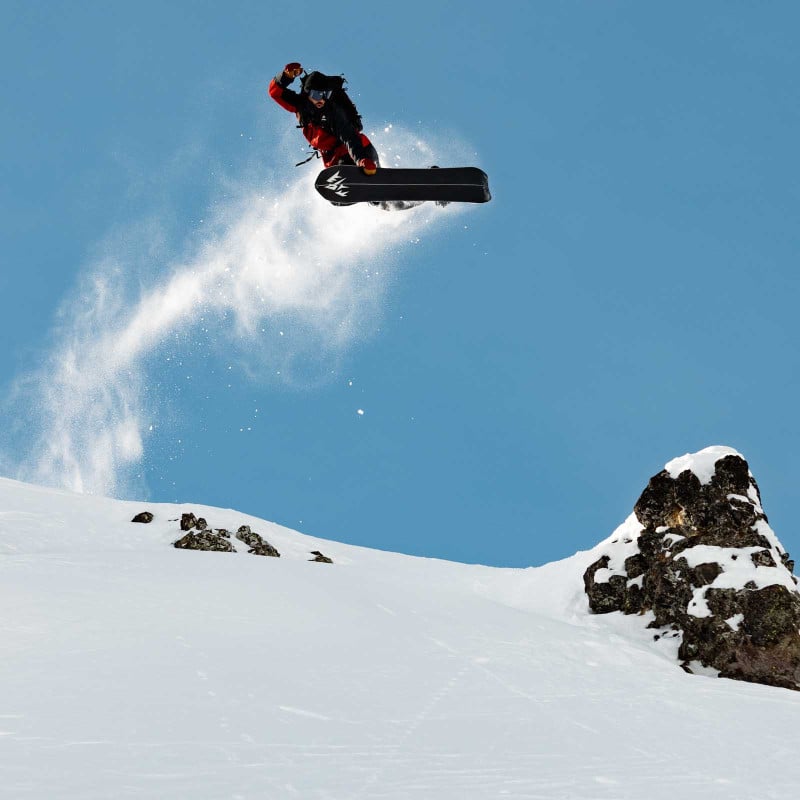




One of the biggest evolutions in evaluating backcountry travel and avalanche safety is the frequency and ease of getting your local avalanche report. With a smart phone you can pull up the report including a video of a snow pit dug by an expert that same day in under fifteen seconds.
Your local forecast is an amazing tool and should be used every day you head out into the backcountry. Here are some of the things that I think about as I read the report and then decide where to go ride based on the danger rating:
LOW – Late afternoon wet slides are the only avalanche risk with this rating. I will ride over secondary exposure in this rating. My main concern is hitting undetected white ice on a steep slope and not being able to hold my edge.
“Spooky” MODERATE - (moderate rating with a deep persistent weak layer)
You won’t find the word “spooky” on an avy report but I call it this because moderate is the most dangerous rating there is in my mind. Moderate means that it is unlikely something will slide but if it does, the slide will be massive and probably kill you. This is the rating that kills the experts (Craig Kelly and Steve Romeo are two examples.) I pretty much treat moderate as considerable unless the weak layer is not that deep and I am not worried about large propagating slides. I expect all convex rolls and anything over 45 degrees to slide.
CONSIDERABLE – I tread very lightly in this rating. Depth of slab and the chance for large propagating slabs change this rating to high for me. Having a safe route to the top is also essential as you’re often climbing through the same terrain you’ll ride down. On the descent I look for terrain with lots of islands of safety and stay away from big bowls and faces. I expect everything over 35 degrees to slide.
HIGH – With a high rating I am most likely riding a resort. I will go on a below 30 degree tour in terrain I know very well and does not have any avalanche terrain above me. Tours like these are more like going cross-country skiing then snowboarding…which is why I usually ride a resort.
When there has been a lot of fresh snow or there is a buried weak layer I also bump up the danger rating. Here are a couple red flags that I look for:
Persistent weak layers – This is a major red flag on a report. This means there is a bad layer deep within the pack that is not healing. In some cases this bad layer never completely goes away. It may lay dormant for weeks at a time but if triggered in the perfect spot it can result in a massive avalanche.
Depth of Slab – Avy danger ratings are based on the likelihood of an avalanche happening and do not take into account the depth of slab. There is a huge difference between a 10” slab and a 3’ slab. A very small avalanche, 1/2 a volley ball court, is very serious when it is a 3 ft deep slab or deeper. When the size of the slab is deeper then two feet I bump the rating up a notch. High = Extreme, Considerable = High, Moderate = Considerable. Low always stays low.
The snowpack is always guilty until proven innocent in my mind. Unless the report is low I always ask myself, “what happens if the face I am on slides?” Picking clean lines and avoiding terrain traps/secondary exposure is always the name of the game no matter what the report is.
Ride to live another day!